 Paper
Highlights
Unified agentic framework
A novel and unified agentic mHealth framework supporting reactive question answering and proactive monitoring via shared memory and tools.
Tool-augmented over raw signals
A tool-augmented reasoning interface that enables dynamic computation over raw ECG/PPG signals — invoking structured tools instead of reasoning over static summaries.
VitalBench & gains
A longitudinal benchmark of 1,862 QA pairs for reactive questions and 90.2 hours of data for proactive monitoring. VitalAgent outperforms reactive baselines by over 25%.
Abstract
Wearable devices enable continuous monitoring of physiological signals such as ECG and PPG, but existing mHealth systems are largely limited to task-specific prediction pipelines or reactive question answering over static summaries. They lack the ability to support temporal reasoning, persistent physiological context, and proactive monitoring over long-term signal streams. We propose VitalAgent, a tool-augmented agentic framework for ECG/PPG-based mHealth that supports both reactive question answering and proactive monitoring. VitalAgent is built on a longitudinal physiological memory and a tool-augmented reasoning interface that enables dynamic computation over raw signals. We further introduce VitalBench, a longitudinal physiological monitoring benchmark dataset comprising 1,862 QA pairs for reactive question answering and 90.2 hours of continuous ECG/PPG recordings for proactive monitoring, covering cardiac, physical activity, and stress-related tasks. Experiments demonstrate that VitalAgent achieves over 25% improvement over prompt-based and ReAct baselines in reactive evaluation and supports proactive alert monitoring over long-term physiological signals, highlighting the importance of dynamic tool use and long-term physiological monitoring.
Method
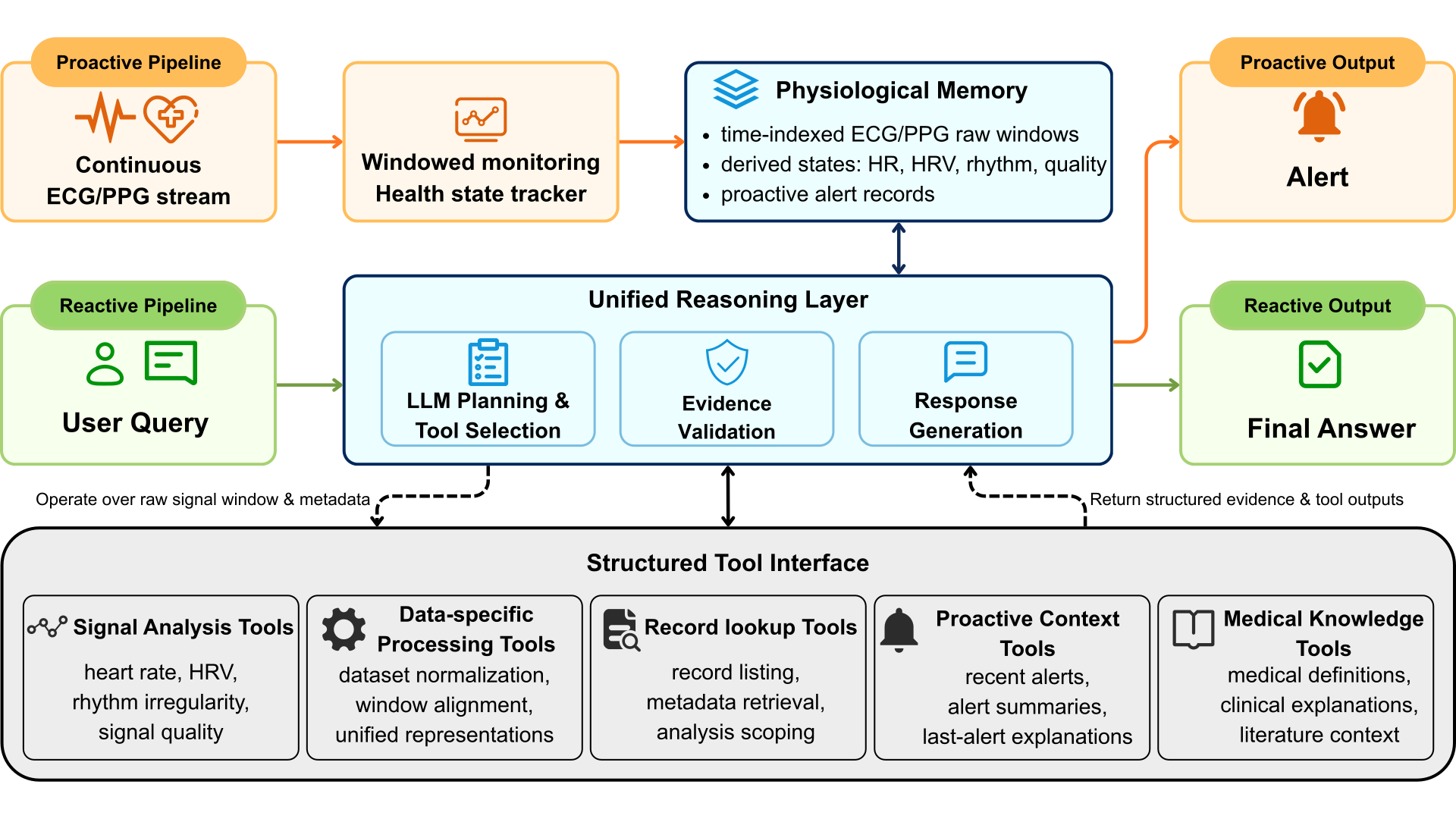
VitalAgent is built on a longitudinal physiological memory and a tool-augmented reasoning interface that enables dynamic computation over raw signals.
Two operating modes
Core components
A longitudinal record of three things: the history of raw ECG/PPG signal windows, a streaming health-state tracker updated from previously processed windows, and previous proactive alert records.
A unified policy interface of three components, shared by both modes: an LLM-based planner for tool selection, an evidence validation module, and an LLM-based response generator.
A structured tool registry spanning 29 tools across five categories: signal analysis (13), data-specific processing (3), record lookup, proactive context, and medical knowledge.
Results
Reactive question answering
Accuracy on the test split (635 Tier-A + 670 Tier-B). Under the leakage-free setting baselines compute their own states; under the oracle setting they are additionally given numerical states (label-derived states excluded). VitalAgent reads raw signals directly.
| Method | Tier A · window-local (635) | Tier B · temporal (670) | ||||||
|---|---|---|---|---|---|---|---|---|
| Overall | Verify | Choose | Query | Overall | Verify | Choose | Query | |
| Leakage-free setting | ||||||||
| Health-LLM (zero-shot) | 0.499 | 0.389 | 0.612 | 0.650 | 0.282 | 0.553 | 0.139 | 0.095 |
| Health-LLM (few-shot) | 0.488 | 0.365 | 0.624 | 0.642 | 0.300 | 0.561 | 0.191 | 0.095 |
| Health-LLM (few-shot CoT) | 0.483 | 0.348 | 0.635 | 0.650 | 0.296 | 0.541 | 0.201 | 0.095 |
| LifeAgent* (tool-calling) | 0.545 | 0.474 | 0.612 | 0.650 | 0.287 | 0.545 | 0.165 | 0.095 |
| PHIA (ReAct + code) | 0.202 | 0.082 | 0.465 | 0.171 | 0.148 | 0.243 | 0.191 | 0.000 |
| VitalAgent ours | 0.860 | 0.877 | 0.729 | 0.992 | 0.557 | 0.741 | 0.443 | 0.443 |
| Oracle setting | ||||||||
| Health-LLM (zero-shot) | 0.784 | 0.678 | 0.841 | 1.000 | 0.588 | 0.773 | 0.232 | 0.688 |
| Health-LLM (few-shot) | 0.820 | 0.728 | 0.876 | 1.000 | 0.558 | 0.729 | 0.402 | 0.498 |
| Health-LLM (few-shot CoT) | 0.776 | 0.643 | 0.882 | 1.000 | 0.496 | 0.627 | 0.418 | 0.412 |
| LifeAgent* (tool-calling) | 0.819 | 0.725 | 0.876 | 1.000 | 0.652 | 0.800 | 0.418 | 0.688 |
| PHIA (ReAct + code) | 0.395 | 0.246 | 0.612 | 0.512 | 0.227 | 0.310 | 0.278 | 0.086 |
Bold = best under the leakage-free setting; underline = best
under the oracle setting.
*Code not publicly
available; pipeline reproduced.
Proactive monitoring
AF-onset monitoring over 90.2 hours across 69 patients.
Adding the LLM judge substantially reduces median alert latency (220 s → 105 s), enabling earlier surfacing of potentially relevant abnormality. Per-window AF rhythm classification achieves balanced accuracy of 66.7% across both cohorts, with AF sensitivity of 75.5%.
VitalBench
A longitudinal physiological monitoring benchmark dataset covering cardiac, physical activity, and stress-related tasks.
906 instantaneous questions answered from a single signal window (e.g. “am I in AF right now?”, “where does my heart rate fall?”).
956 questions requiring aggregation across multiple windows (e.g. “how often have I had AF lately?”, “is my heart rate higher than before?”).
Built from Icentia11k, AF-PPG-ECG, PPG-DaLiA, and WESAD — covering cardiac, physical-activity, and stress tasks.
Trace Replays
Every replay below is from a real recorded run — the queries, tool chains, and grounded answers are preserved from recorded VitalAgent outputs. No live model calls are made on this page.
Reactive question answering Reactive
Pick a case on the left. Each is a real recorded run — VitalAgent routes the query to a tool chain over the raw signal and grounds its answer in the tool outputs. Cases 1–2 ask the same AF question on different signal sources, and the agent picks a different tool chain for each.
Proactive monitoring Proactive
VitalAgent also replays ECG streams in a streaming-style monitoring setting and flags AF-related rhythm episodes with measured detection latency. Below is a ~33-minute recording played back in fast-forward: the strip shows the true rhythm (green = normal, red = AF), and each flag marks where VitalAgent detected an AF episode and how many seconds it took. The goal is to catch episodes with low delay while controlling false alerts.
BibTeX
@article{zhu2026vitalagent,
  title   = {VitalAgent: A Tool-Augmented Agent for Reactive and Proactive
             Physiological Monitoring over Wearable Health Data},
  author  = {Zhu, Di and Wu, Yu Yvonne and Jia, Hong and Saeed, Aaqib
             and Kostakos, Vassilis and Dang, Ting},
  journal = {arXiv preprint arXiv:2605.29483},
  year    = {2026}
}